
Imagine a scenario where one of the largest exchanges identifies a $50 million unlawful withdrawal.
Within minutes that sum has been automatically routed, divided between multiple assets and blockchains and credited to addresses associated with a number of foreign platforms.
The victims' emergency task force immediately seizes the initiative informing authorities tracing the trail of funds on public blockchains, identifying which deposit addresses on which platforms now hold the stolen assets.
The problem begins then, with an almost impossible task at hand.
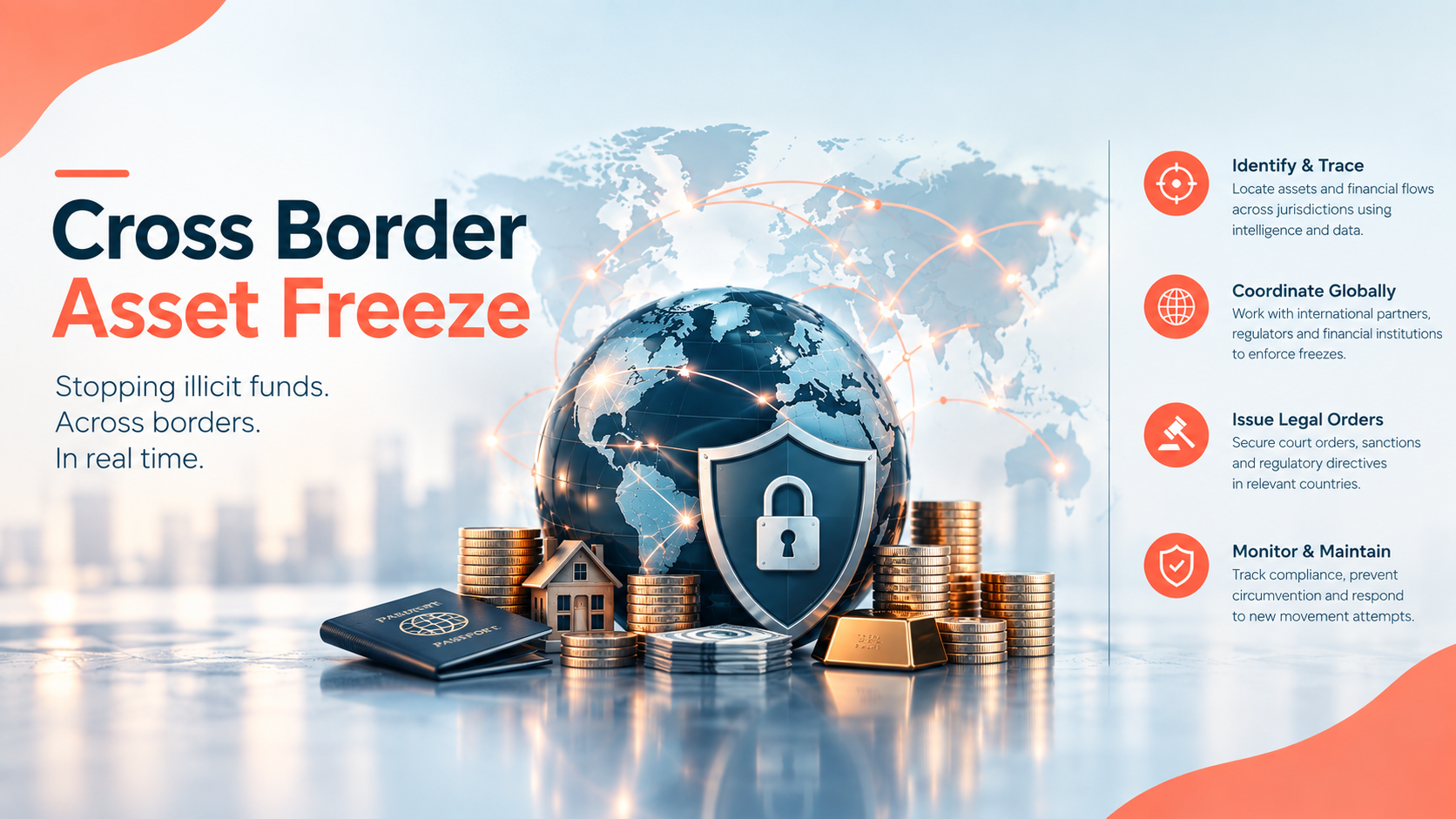
It takes seconds to identify where stolen funds exist on a public ledger but days, weeks or even months to secure legal jurisdiction, a court order or even an agreement with the relevant foreign exchange platform to freeze these funds, before they're moved, bridged, or “off-ramped”.
The “Enforcement Bottleneck” is the tension felt between the speed of crypto-transfer and the legal friction of cross-jurisdictional asset freeze procedures.
The Speed of Transfer vs the Friction of Seizure Domestically a simple account freeze takes place within the constraints of standard financial
investigative procedures.
A court freezes a suspect's account, which the victim's emergency task force might do after identifying the relevant banking institution.
With cross-border crypto-investigations and the nature of the asset itself (decentralized, un-custodial, multi-jurisdictional) this process is severely complicated by the following factors:
I. Automated Asset Dissipation
Bad actors are completely aware that public ledgers are monitored and the FATF's own Asset Recovery Guidance highlights that “virtual assets enable traditional money laundering techniques to be applied more quickly and across multiple jurisdictions” (para 7). Time is of the essence and the opportunities for investigators to take provisional measures are being reduced.
II. Jurisdictional Fragmentation
Funds are typically fragmented across jurisdiction, including “slow” jurisdictions which have weak legal assistance frameworks or procedures.
III. “Voluntary” Compliance Limits
While some centralized exchanges have dedicated contact points for law enforcement who can respond immediately to emergency requests, the ability to “voluntarily” comply by freezing accounts is dependent on the entity's corporate structure and the potential civil liability that could be owed to an
account holder, if incorrect action is taken.
Voluntary compliance mechanisms may well be appropriate but law enforcement agencies should recognize the limitations of this approach when it
comes to binding third-parties with legal jurisdiction.
When voluntary measures are unavailable or insufficient, law enforcement may have to move through a formal legal framework, which can involve; obtaining a domestic court order, making an application through international legal frameworks such as UNCAC Article V or UNTOC Article 18 or satisfy the
requirements of a requesting foreign judiciary in order to get cooperation from target assets' host foreign exchange platforms.
IV. The Sovereignty Principle
Why can't agencies simply apply, directly, for a foreign court order to freeze the account or property of a suspect or target in a foreign jurisdiction? The basic answer is that such foreign courts may not acknowledge such a request as valid, given the principle of territorial sovereignty.
A foreign state or law enforcement agency generally cannot act unilaterally to freeze property, accounts or even a suspect without local jurisdiction in another sovereign state.
This typically requires the involvement of a local court and appropriate legal procedures for mutual legal assistance.
The practical implications of this are clear:
1. Risk of Overreach/Liability
Requests (particularly from foreign agencies) without appropriate local jurisdiction can end up being contradictory and potentially expose local organizations to civil and regulatory liability.
2. Multi-jurisdictional Procedures
Applying for appropriate freezes in multiple jurisdictions simultaneously can require different procedures and levels of evidence.
3. Weak Link/Liability Risk
As mentioned in the FATF Guidance if a competent authority in any jurisdiction (involved in an investigation, mutual legal assistance or reciprocal arrangement) delays taking action (or responding) bad actors will exploit this and potentially undermine other Freeze measures.
4. Reimagining Cross-Jurisdictional Enforcement
The typical jurisdictional asset recovery landscape in international law enforcement involves responding to a “real-time or near-real-time transfer of crypto assets” with “slow and multi-jurisdictional” freezing procedures.
INTERPOL's recent launch of the Global Rapid Intervention of Payments system (I-GRIP) certainly helps with the speed and volume of traditional financial instruments but cross-border virtual asset restraint is currently limited by the legal implications that come with voluntary requests.
How can law enforcement investigate and respond to bad actors and bad systems without violating the legal and regulatory frameworks of sovereign states?
Law enforcement and regulators in several jurisdictions are beginning to ask themselves a related but more practical question: How can agencies develop and operationalize a framework where the speed of cross-border asset freezes can
“match” the speed of digital asset movement?
As global law enforcement leaders meet at the 5th INTERPOL New Technologies Forum (NTF) in Vienna at the Complexity Science Hub, on 29-30 September 2026, the challenges faced and legal constraints of cross-jurisdictional crypto-investigations are coming under the sharpest scrutiny.
BLK CORAL
← Back to insights